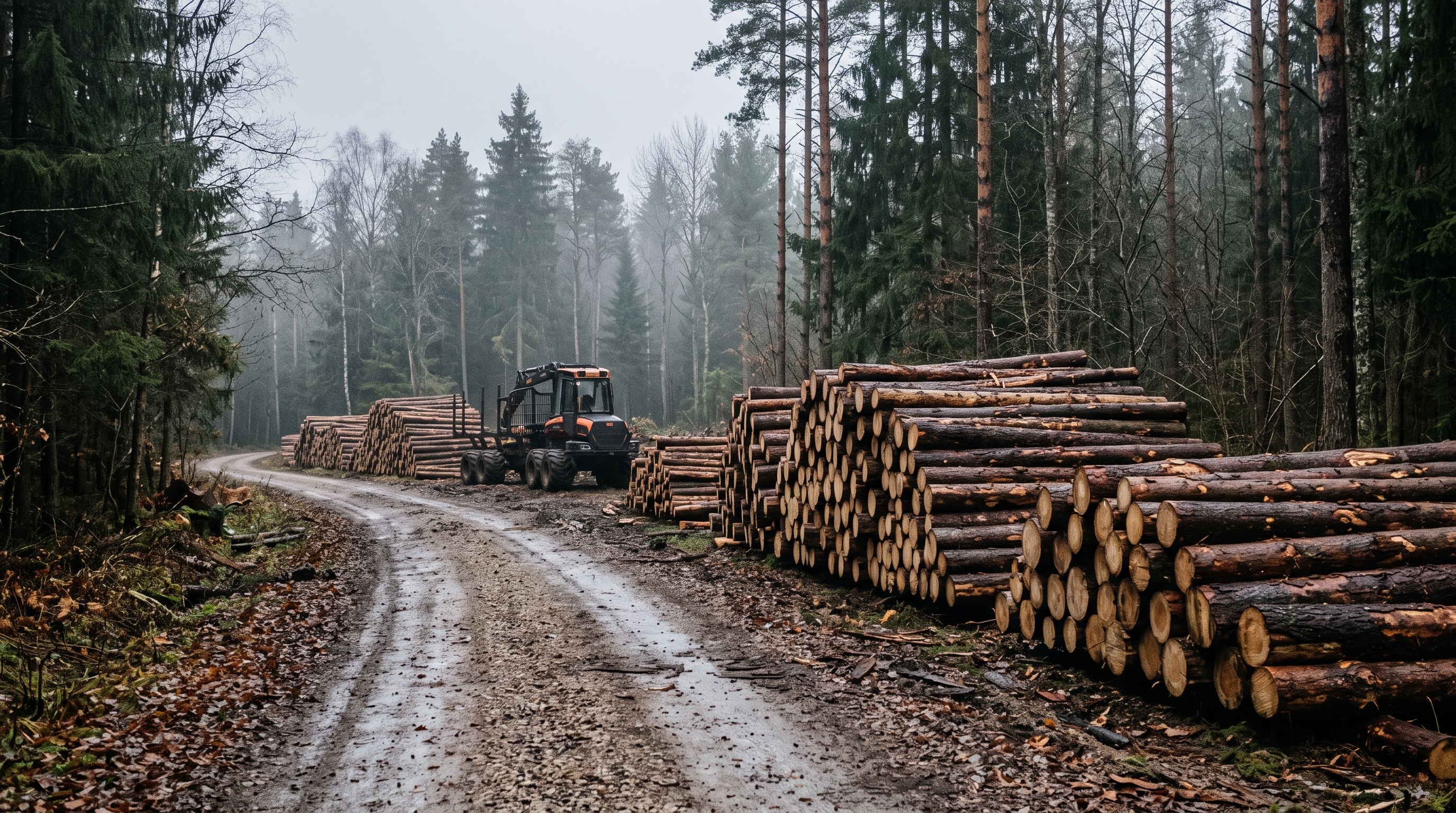
A company that buys standing timber and fells it itself is, from 30 December 2026, almost always the operator under EUDR. Which regime applies depends on its size: a small firm files one simplified declaration, a medium or large one files full DDS with coordinates for every plot.
From 30 December the operator is whoever fells
If your company buys standing timber and harvests it itself, then from 30 December 2026 the obligations under Regulation (EU) 2023/1115 (EUDR) almost certainly sit with you, not with the forest owner. Standing trees are outside the regulation; the product comes into existence at harvest, and the operator is whoever owns the logs at that moment.
After that, everything turns on company size. A micro or small undertaking selling its own harvest files one simplified declaration. A medium or large one files full due diligence statements (DDS) with the geolocation of every plot. Neither gets a deferral to mid-2027 for timber.
Key takeaways
- The buyer of a felling area is the operator if the contract makes it the owner of the logs at the moment of harvesting (Commission FAQ, point 3.12).
- The regime follows the size of the operator, not of the landowner: a small firm files a simplified declaration, a medium or large one a full DDS (point 3.21).
- A small firm fells on new plots every year: the declaration can be updated, and the actual places of harvest must be documented (point 3.27).
- For timber there is one date of application — 30.12.2026, micro and small undertakings included (Article 38(3) of the regulation).
- The operator must pass the DDS reference number or the declaration identifier to its buyer.
When the operator is you
The European Commission's guidance (FAQ, version 5, point 3.12) gives a single test: the party carrying out the harvest is the operator if it directly and automatically becomes the owner of the logs by the mere act of harvesting. If the contract or national law transfers ownership to it only after harvesting, the forest owner remains the operator.
In practice "bought the timber" covers three different situations. You bought a felling area (cirsma) and fell it yourself — you are the operator. You provide a harvesting service and the assortments remain the owner's — the owner is the operator and you are a contractor. You buy assortments already harvested at the roadside — the owner is the operator, you are a downstream operator, and you must receive the declaration number from the owner. Check the contract clause on transfer of ownership: it is what defines your role.
Which regime applies to you
The simplified regime is for the "micro or small primary operator": a natural person, or a micro or small undertaking, established in a low-risk country and placing on the market products it has harvested itself in that country. A firm that becomes the owner of the logs at harvest fits the definition: FAQ point 3.21 states that where operator and landowner differ, it is the operator's size that decides.
Size is assessed under Directive 2013/34/EU. An undertaking is small if it does not exceed at least two of three limits: balance sheet total EUR 5 million, net turnover EUR 10 million, 50 employees. The category changes only when the limits are exceeded, or cease to be exceeded, for two consecutive financial years (point 3.24). Latvia is classified as a low-risk country by Regulation (EU) 2025/1093.
- A micro or small firm selling its own harvest: one simplified declaration and a declaration identifier.
- A medium or large firm: a full DDS with the geolocation of all plots before the timber is placed on the market.
- A firm that also imports timber from outside the EU: a DDS for the imports, a simplified declaration for its own harvest if its size allows (point 3.23).
The simplified declaration when the plots keep changing
The simplified declaration is filed once in the EU Information System, before timber is first placed on the market. It gives the operator's name and address, the product code and description, a one-off estimate of annual quantity, the country and the plots of harvest, and a statement that due diligence is exercised (Annex III of the regulation). Geolocation of the plots may be replaced by a postal address or cadastral details, provided they identify the plot unambiguously (Article 4a(5); FAQ, point 3.28).
A forest owner's plots stay the same; a harvester's do not. The FAQ takes this case separately, using a harvesting company as its example (point 3.27): it fells on different plots each year, including plots that arise after the declaration was filed. The information in the declaration should be accurate, so the company can update the list of plots — and, above all, must document the actual places of harvest and be able to justify any discrepancy between what was declared and what happened.
Hence the working rule: for every felling area keep the cadastre number, the compartment numbers and the felling documents, even though there is one declaration for the whole year. And do not understate the size of the firm: if the competent authority finds that information was provided in order to qualify for the simplified regime, that is treated as a breach of the regulation, with penalties (point 3.27).
The full DDS: what a medium or large firm needs
A medium or large firm files a due diligence statement before the timber is placed on the market and receives a reference number. One statement can cover several consignments and several products, but for no longer than a year from submission, and in principle it should relate to timber already harvested; the exception is stable plots with unchanged conditions (FAQ, point 5.19). Once the declared quantity has been used up, a new statement is filed for the next quantity.
Because Latvia is a low-risk country, due diligence is simplified: the information required by Article 9 of the regulation still has to be collected, but risk assessment and risk mitigation are not required — unless information pointing to a risk of non-compliance comes to light (Article 13). The operator reviews its due diligence system once a year and keeps records of its statements for five years.
- Geolocation of all plots of harvest: a polygon for a plot of more than 4 ha, a point or a polygon for a plot of less than 4 ha, to six decimal places (FAQ, points 1.1 and 1.8).
- Date or time range of production: for timber, the duration of harvesting operations on the plot (point 1.25).
- Quantity and product code; the declared quantity must correspond to what is actually placed on the market.
- The file size of one statement may not exceed 25 MB (point 1.7).
The date: 30 December 2026, with no deferral for small firms
The regulation applies from 30.12.2026. The deferral to 30.06.2027 for natural persons and micro and small undertakings comes with an exception: it does not cover products listed in the annex to the old Timber Regulation (EU) No 995/2010 (Article 38(3)). Roundwood (code 4403) and fuel wood (4401) are in that annex.
The Commission confirmed it on 13 July 2026: from 30.12.2026 the regulation applies to large and medium operators and to micro and small operators already covered by the Timber Regulation. A small harvesting firm has to be ready on the same date as a large one.
What to collect for every felling area
Whichever regime applies, the operator answers for the accuracy of the information on the place of harvest, even when the owner supplied it (FAQ, points 1.11 and 1.12). So ask for the plot file when the contract is signed.
- The cadastre number and the block and compartment (nogabals) numbers where felling takes place.
- The felling-area sketch with its boundaries.
- The felling confirmation (ciršanas apliecinājums) — the document that allows felling to start under the Forest Law (Meža likums).
- The contract, with its clause on transfer of ownership of the harvested timber.
- The start and end dates of work on the plot.
Coordinates and the MezaData EUDR passport
You can take the coordinates yourself, with a phone or a handheld receiver; the Commission expressly names that as an acceptable method (FAQ, point 1.1). With dozens of felling areas a year, though, it is easier to start from ready-made boundaries — of the felling areas in a permit or of the compartments — and check them on the ground.
The MezaData EUDR passport builds this from a felling confirmation number or a cadastre number. With a permit number it takes the exact felling-area boundaries from the public permit service of the State Forest Service (Valsts meža dienests, VMD); with a cadastre number you tick the compartments. The passport is free, with no sign-up and no email. You get a page with the register details, the share of forest cover on 31.12.2020 from the EU reference map JRC GFC2020, and one GeoJSON file in the EU format, in which each separate part of a plot is its own polygon. The page can be printed or saved as PDF, and its link stays valid for 5 years.
For many felling areas there is a batch export. With a buyer account, once access is enabled on request, you paste a list of permit and cadastre numbers and get one ZIP archive: the GeoJSON split into parts of no more than 25 MB each, a manifest with one row per compartment, and every passport.
The limits matter. The register data is VMD open data, refreshed quarterly. In permit mode the boundary is the felling area, but species and register signals describe the whole compartment; in cadastre mode the file describes whole compartments, not the felling-area boundary. The GFC2020 map is EU reference data and not legally binding. The passport shows register facts but does not certify compliance — the operator files the statement and answers for it.
What your own customers expect from you
A sawmill or trader buying timber from you files nothing. But it must keep details of its supplier and, where the supplier is an operator, the DDS reference number or the simplified-declaration identifier (Article 5 of the regulation; FAQ, point 3.4). Passing the number on is your obligation, not theirs.
A buyer that knows you are an operator may not place your timber on the market without that number. Large buyers — those that are not SMEs — must additionally register in the Information System and, where there are substantiated concerns, verify that due diligence was exercised. The practical point: the number has to be on the delivery documents by the first delivery after 30 December.
Enforcement and fines
Penalties are set by each member state. The regulation fixes a floor for the ceiling: the maximum fine for a legal person may not be lower than 4 % of its annual EU-wide turnover (Article 25). We do not quote Latvian amounts here — check them against the legislation in force.
According to Latvia's Ministry of Agriculture (Zemkopības ministrija), the State Forest Service (VMD) will continue as the competent authority for timber. Checks focus on operators — that is, on those who fell and sell first.
What to do before 30 December
Less than three months remain, and the winter harvesting season will already run under the new rules. The sequence is the same for a small firm and a large one; only the fourth step differs.
- Go through your current contracts: where you own the logs from the moment of harvest, where you are a contractor, where you buy assortments.
- Work out the firm's size against the three limits for the last financial year and keep the calculation on file.
- Register in the EU Information System; the links and a user guide in Latvian are on the ministry's page.
- A small firm: file the simplified declaration before the first sale. A medium or large firm: set up the routine for collecting geolocation and filing DDS.
- Start a record for every felling area and agree with your buyers how you pass the number on.
FAQ
We are a small firm buying felling areas. Is the simplified declaration enough?
Yes, if under your contracts you become the owner of the logs at the moment of harvesting and the firm stays within the small-undertaking limits. The declaration is filed once, but the list of plots is worth keeping current and the actual places of harvest must be documented. Where you buy some timber already harvested, you are not the operator for it and must receive the number from the seller.
The forest owner is a private individual. Does the owner file anything?
No, if you are the operator: standing trees are outside the regulation. What you need from the owner is accurate plot data and the felling documents. The owner's side is covered in the article for forest owners.
Can one statement cover the whole season?
A full DDS can cover several consignments, but for no longer than a year and in principle only timber already harvested (FAQ, point 5.19). A simplified declaration is filed once and is not tied to consignments; it is updated when new plots are added.
Sources
- Regulation (EU) 2023/1115 — the EUDR base text (eur-lex.europa.eu) — Articles 2, 5, 9, 13, 25.
- Regulation (EU) 2025/2650 — the December 2025 amendment (eur-lex.europa.eu) — Articles 2(15a), 4a, 38 and Annex III.
- Regulation (EU) No 995/2010 — the former Timber Regulation (eur-lex.europa.eu) — the annex listing codes 4401 and 4403.
- European Commission — "Frequently Asked Questions: Implementation of the EU Deforestation Regulation", version 5 — points 1.1, 1.7, 1.8, 1.11, 1.12, 1.25, 3.4, 3.12, 3.21, 3.23, 3.24, 3.27, 3.28, 5.19.
- European Commission — news of 13.07.2026 on the product scope and the Information System — confirmation of the dates of application.
- Ministry of Agriculture of Latvia — "ES Atmežošanas regula (EUDR)" — access to the Information System, user guide, small-undertaking thresholds.
Disclaimer
This text is not legal advice. It describes the regulation and the Commission's guidance as they stood on 5 October 2026; the Commission's guidance is not legally binding, and the national rules for applying the regulation in Latvia may still be refined. Who the operator is in a particular deal depends on the terms of the contract — if in doubt, consult a lawyer or the State Forest Service.